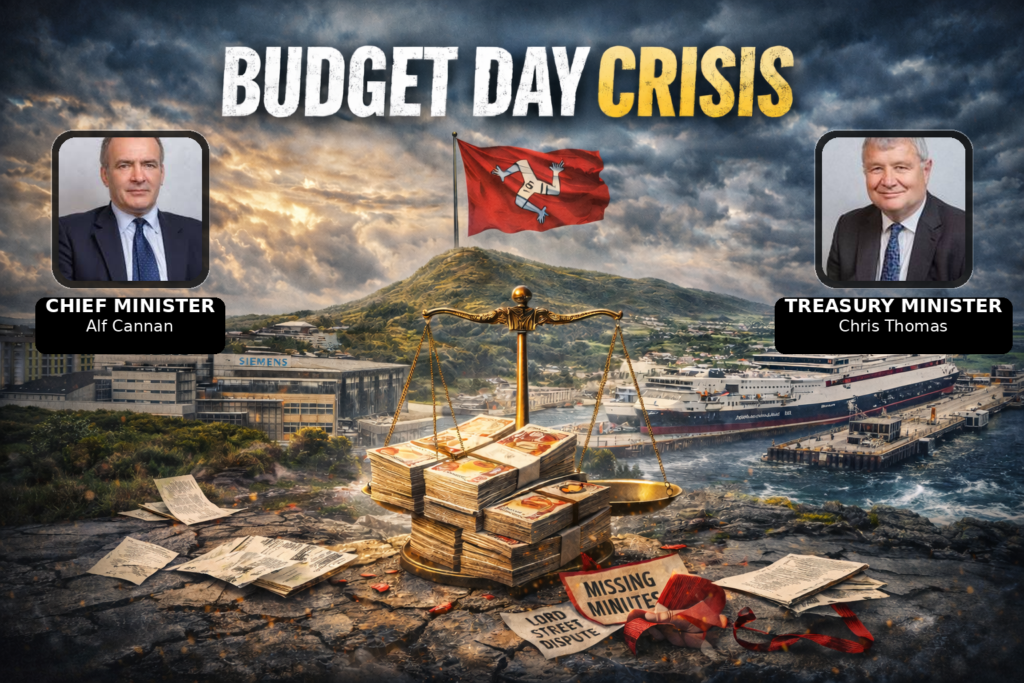
Byline Investigates finds out….in Part 3 of our special report
- ‘The new ferry terminal?’ Lord Street fears grow as the Island remembers Liverpool’s cost spiral
- Budgets don’t stay put: what starts as a forecast can snowball through delay, dispute and ‘close-out’
- Funding pot exhausted: ministers confirm approved sums have been used up — more may follow
- Legal sensitivity: officials won’t pin down final totals — critics say that’s how numbers balloon
- £90m exposure: taxpayer liability hangs over the long-running Lord Street litigation
- MONEYVAL looming: watchdog assessment due September/October 2026
- Experts and campaigners pile in…. but Isle of Man Financial Service Authority agrees grey listing would be bad.

By Catriona Harrison
The Isle of Man is staring down a familiar risk: a major public controversy in which nobody can say, with confidence, what the final bill will be.
As the £90 Million Lord Street litigation grinds on, critics argue the pattern is starting to rhyme with the Liverpool ferry terminal’s botched budget.
A project that moved from estimates and approvals into an open-ended ‘close-out’ phase in which delay, dispute and professional fees turned forecasts into eye-watering totals.
With MONEYVAL due to assess the Island’s anti-money laundering effectiveness in September/October 2026, campaigners are warning of looming disaster.
A prominent Isle of Man businessman told Byline Investigates: ‘Has anyone realised that the meter is running on the £90 Million Lord Street case – and the Island is paying for delay. Every month of drift inflates the damage exposure.’
In Part 1 of our special report, we delved into the background of the Isle of Man’s infrastructure woes.
In Part 2, Byline Investigates revealed how the Island’s government is trying to cope with the growing PR crisis around what’s been dubbed the dreaded the ‘Double L’ scandal surrounding Lord Streets and the Liverpool ferry terminal.

Critics claim that governance, record-keeping and procurement discipline are no longer just domestic political issues – they are part of a wider reputational risk story.
Byline Investigates found that the escalation of Lord Street’s potential costs mirrors the budget-busting timeline of the ferry terminal’s now familiar money pit.
By the end of 2021, the Isle of Man’s parliament Tynwald had approved terminal funding rising to about £70.6m/£70.7m.
Ministers now confirm that pot – plus an additional £2.12m from the capital inflation fund – has been fully exhausted, with a supplementary vote expected if more is needed.
Parliament’s own Public Accounts Committee later summarised the rocketing fees starkly.
From an early estimate of £18m in 2015 to £70.7m by December 2021 – a trajectory it investigated in detail.
The potential £90 million Lord Street bail out could have far worse effects in real life.
‘It’s not just a spreadsheet exercise. The ferry fiasco has drained the coffers,’ the businessman told Byline Investigates. ‘The Isle of Man cannot afford a second hit.’
The £90 million Lord Street case could strain pension reserves and could also trigger a technical default, affecting the Island’s ‘gold-standard credit rating’, according to experts.
Dr. Nicholas Ryder, a financial crime advisor and researcher, says that a grey listing evaluation could, ‘signal weaknesses in the Isle’s anti-money laundering and counter-terrorist financing systems’.

The Lord Street project – turned court case – was expected to transform an old bus station in Douglas into a leisure and retail complex but is now used as a car park.
The project was brought to a halt in 2016 as Sondica Group Inc, a development company based on the Isle of Man, accused the Government of breach of contract and of mishandling important documents.
The Isle’s developer won the contract and had drawn up detailed plans of a cinema, shops and a new car park, but, in 2016, a high-level steering committee reversed the decision and opened to new bids.
Dr. Ryder continues; ‘Such an evaluation could increase the risk that the Isle of Man is subject to heightened international scrutiny or effectively treated as higher risk by the Financial Action Task Force (FATF) and corresponding banks.
‘This often results in reduced investor confidence, higher compliance costs for local and international financial institutions, and potential restrictions or delays on cross-border transactions.’
In the face of a potential ‘grey listing’ evaluation, a spokesperson from the Isle of Man Financial Service Authority says that; ‘Preparations are well advanced across multiple Government agencies to demonstrate that the Isle of Man complies with global standards.’
The spokesperson says that ‘data gathering and analysis have been stepped up as part of the Island’s commitment to combatting money laundering, the financing of terrorism and the financing of proliferation of weapons of mass destruction.’
Since the last evaluation in 2016, the island has ‘positively marked 39 out of the 40 FATF recommendations’ which has placed the Isle of Man ‘among a select group of nations in the world for technical compliance in Anti-Money Laundering (AML) and Countering the Financing of Terrorism (CFT)’, says the Authority.
However, the Financial Services Authority does recognise that the outcome will be crucial to the Island’s continued economic success.
‘It is acknowledged that ‘grey listing’ would negatively impact the Isle of Man’s finances and reputation. By way of comparison, one listed jurisdiction estimated a loss to its economy of £38 billion – 11% of its GDP.’
‘The standards for compliance in the sixth-round evaluation taking place in September/October 2026 will be higher than before and require the Island to provide considerable evidence of the long-term effectiveness of its AML/CFT regime and how supervision and enforcement measures are applied in practice.’

The island’s Financial Services Authority recognises that strong public-private sector collaboration is fundamental to the Island’s preparations and is continuing to roll out an outreach programme.
The spokesperson concludes that; ‘This level of scrutiny is not unique to Isle of Man. The goal is to ensure there are no weak links in the global fight against financial crime.’
Meanwhile, the Liverpool ferry terminal saga drags on – and the comparisons to the Lord Street case are played out on social media, in legal circles and in business forums.
Ministers cite legal sensitivity on final figures – but critics say the lesson from the ferry terminal for the £90 million Lord Street case is clear: delay and dispute can turn forecasts into eye-watering totals.
The terminal opened to passengers in June 2024 after repeated delays, yet the argument over the final account – and what can be recovered – has dragged on well beyond opening day, leaving the public without a settled bottom line.
That prolonged ‘close-out’ phase is precisely what critics fear could echo in Lord Street: when disputes harden, costs do not just sit in a single number — they accumulate through process, professional fees, and time.